I drove through four different neighborhoods last weekend - different parts of town, different price points, different architectural styles. I counted eleven matte black or near-black garage doors. Three years ago I would've counted maybe one.
Something has shifted. And it's not slowing down.
Black garage doors aren't just popular right now. They're in the process of replacing gray as the default modern exterior choice - which is a bigger deal than it sounds, because gray was king for almost a decade. When a dominant neutral gets displaced, it tends to stay displaced.
What I want to do here isn't just tell you black is trending. You can see that yourself. I want to explain why it works so well, which houses it genuinely suits, and the one real risk that most articles gloss over entirely.
Why black is winning, specifically
Dark colors on exterior surfaces have always existed. What changed is the finish technology and the context. Matte black in particular looks different on a modern door than it did on the painted wooden doors of twenty years ago. The factory-applied powder-coat finishes available today are smooth, consistent, and architectural in a way that brushed-on paint never was.
But beyond the product quality, there's a design logic to why black works so well on a garage door specifically.
Your garage door is the largest single surface on most home fronts. It accounts for roughly 30% of the visible facade. A surface that size, done in a mid-tone that kind of matches the siding, just becomes visual noise. Your eye passes over it. It contributes nothing.
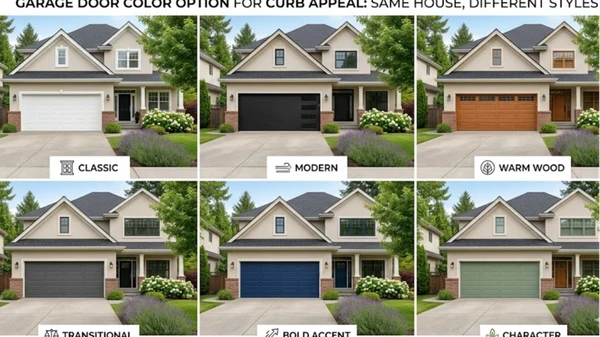
A black door against a light-colored exterior does the opposite. It creates a focal point. It signals that someone made a deliberate choice. In exterior design, intentionality reads as value - and that impression happens in about three seconds, before anyone consciously processes what they're looking at.
The other thing black has going for it that nobody really talks about: it hides grime better than almost any other color. White garage doors look dingy after one bad pollen season. Light gray shows water streaks. A matte black door in the same conditions just looks like a matte black door. Less washing, longer periods between cleanings where it still looks sharp. Practical and beautiful at the same time is a combination that tends to win.
Honest take on which homes actually pull it off
Not every house is a candidate. Let me be direct about that.
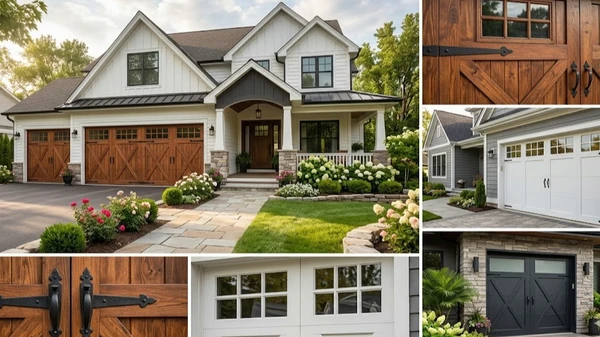
Modern farmhouse exteriors were made for black garage doors. White board-and-batten siding, black window frames, black carriage-style door with crossbuck overlay - the whole thing is a coherent design language and black is what ties it together. This combination works so consistently that it's basically become the defining look of the style.
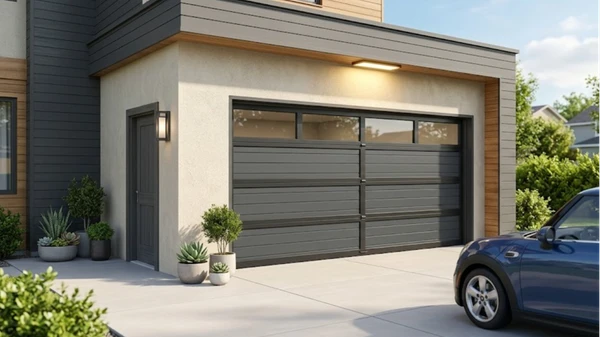
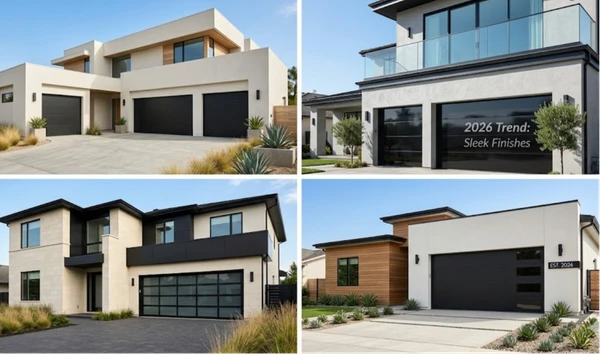
Contemporary homes - especially anything with flat rooflines, large windows, and minimal ornamentation - suit flush-panel black steel or black aluminum-framed glass panels. These look genuinely architectural. If you have a full-view glass garage door with a black aluminum frame, it reads like something designed by someone with actual credentials.
Mid-century ranch homes handle black well too, though it takes some care. A black flush-panel door on a ranch with vertical wood accents and a flat roofline is a sharp update that feels period-appropriate without being costume-y. The key is keeping everything else clean - no ornate hardware, no decorative overlay.
Craftsman bungalows - this one's less obvious. I'd say dark charcoal rather than pure black here, paired with bronze or oil-rubbed hardware. The earthy warmth of Craftsman architecture absorbs deep tones well but can feel cold under stark matte black, especially on smaller homes.
Brick exteriors - warm red or brown brick with a matte black door is the combination I get asked about most by homeowners who aren't sure if it'll work. It works. The warmth of the brick against the depth of the black creates a contrast that feels both classic and fresh simultaneously. Hard to mess this one up.
Where black doesn't work: highly ornate Victorian or Edwardian facades where dark colors read as too heavy. Homes with very dark exterior siding where there's no contrast available. And honestly, any situation where someone is choosing black because it's trendy rather than because it fits - that usually shows.
Matte vs. satin vs. gloss - and why it matters more than people think
Most people pick "black" without thinking much about finish. That's leaving a significant design variable on the table.
Matte is the dominant choice right now for good reason. No reflection, no glare, conceals surface scratches almost invisibly, looks equally good in bright sun and overcast light. If you're uncertain, matte is where to land. It suits every home style on the candidate list above.
Satin sits between matte and gloss - a slight sheen that catches light at certain angles. Gives the door more visual dimension and depth than flat matte. Good choice if you want the door to feel a little more prominent without going full glossy.
Gloss is dramatic up close. It picks up the shadow lines in panel details and overlay patterns in a way that matte doesn't - which can be genuinely beautiful on a carriage door with deep crossbuck overlays. The tradeoff is fingerprints, smudges, and watermarks show more readily. This finish needs more regular wiping to maintain its look.
Textured black - woodgrain texture in a black or near-black finish - is the option most people don't consider and should. The texture breaks up the flatness of solid black and adds warmth that's difficult to achieve with color alone. Very popular on farmhouse carriage doors and mid-century ranch styles.
The heat problem (which is real and underreported)
Here's where I'm going to be more direct than most content on this topic.
Steel garage doors painted or finished in dark colors absorb significantly more solar radiation than light-colored doors. On a south- or west-facing wall in a hot climate, that surface can hit 150 to 160 degrees Fahrenheit on a summer afternoon. That's not an exaggeration and it's not a rare scenario - it's what happens on a normal hot day.
What does that heat do? It transfers inward, raising your garage interior temperature. It stresses the insulation layer inside the door panels over repeated expansion-contraction cycles. And if the door was field-painted with standard black paint rather than designed for dark finish from the factory, you're accelerating every degradation process the door has.
None of this disqualifies black doors in warm climates. It disqualifies the wrong black door in warm climates.
If you're in Texas, Florida, Arizona, California, or anywhere that gets serious summer heat: ask your dealer specifically about thermal break construction (which prevents the exterior metal panel from conducting heat directly to the interior), UV-resistant factory finishes, and whether the door's insulation rating accounts for dark color heat absorption. These aren't exotic features - they're standard options from most quality manufacturers. You just have to ask for them.
Field-painting a standard white door black is almost always a mistake. Don't do that.
Pairings that actually make the look land
A black garage door on its own is half the picture. What surrounds it determines whether it looks designed or just dark.
Black window frames and trim on the house are the most powerful pairing available. When the garage door, the window frames, and the front door hardware all share the same dark finish, the exterior reads as a coherent design system rather than a collection of individual choices.
Exterior light fixtures flanking the garage opening - wall sconces in matte black - serve double duty. During the day they add visual structure. At night they make the whole composition look intentional and welcoming in a way that a plain dark door without lighting context often doesn't.
Light-toned hardscape - pale concrete, light gravel, cream pavers - provides the foreground contrast that makes a dark door pop rather than sink. If your driveway is already a dark asphalt color, this is worth factoring in.
Natural wood accents break up solid black without competing with it. A cedar front door, wood-panel inserts in the garage door itself, or wood-toned soffit material adds warmth that keeps the overall look from feeling cold or industrial.
Is this actually permanent or just a moment?
My honest read: both. Some of the black doors going up right now are trend-following. But the underlying shift in exterior color preference - away from cool mid-tone grays and toward deeper, more grounded palettes - that's real and it isn't reversing.
Gray replaced beige over about a decade and never went back. Black is in the process of doing the same thing to gray. The homes that will look dated in ten years aren't the ones with black doors - they're the ones with flat, cool-toned gray doors chosen in 2018 as the safe modern option.
Done with intention, on the right house, with the right construction for the climate, a matte black garage door is a design choice that ages well. It looks expensive. It photographs well. And increasingly, it just looks right.
Thinking about going dark on your garage door? DoorFixy can help you find the right door, right finish, and right installation for your home's style and your local climate - no guesswork.
Explore more on the DoorFixy blog - garage door styles, colors, brands, and real advice that doesn't talk down to you.