Three years ago my father-in-law tapped the corner of his car against the vertical track pulling out of the garage. Slow impact. He got out, looked at it, bent over squinting at the slight distortion in the steel rail. "It's fine," he said. He drove off.
Six months later I got a call on a Tuesday morning. Door stuck halfway up. Car trapped inside. Guy running forty minutes late to a job site, garage door opener making a grinding sound it had never made before, roller wedged into a groove the bent section had been slowly machining into the steel over thousands of cycles. The door wasn't moving.
The repair bill was roughly three times what fixing the original dent would have cost. I've thought about that gap a lot - the distance between "it's fine" and calling someone on a Tuesday morning.
Track problems are patient. They compound quietly.
The basic anatomy, quickly
A sectional garage door runs on two vertical tracks - one on each side of the opening - that the door climbs as it opens. Those vertical sections curve at the top into horizontal tracks that extend along the ceiling to hold the door open. The curve connecting the two is called the radius section.
Rollers attached to each door panel ride inside all of this continuously. Open the door four times a day and those rollers make about 1,400 passes per year. The track system needs to be straight, plumb, level in the horizontal sections, and solidly mounted to the wall framing the entire time. When any of that breaks down - the shape, the position, the mounting - the whole door feels it.
Bent track: what it feels like and what to do
A bend almost always comes from impact. A car corner like my father-in-law's. A ladder that fell. Debris. Less commonly you get a bend that develops gradually from misalignment stress - the track stressed over thousands of cycles until something buckles.
The signature of a bent track is a noise that happens at the exact same point in the door's travel. Every. Single. Time. Not a general grinding throughout the movement - a specific clunk or scrape at one location. If you can predict it before it happens, you're listening to a roller fighting through a distortion in the metal profile.
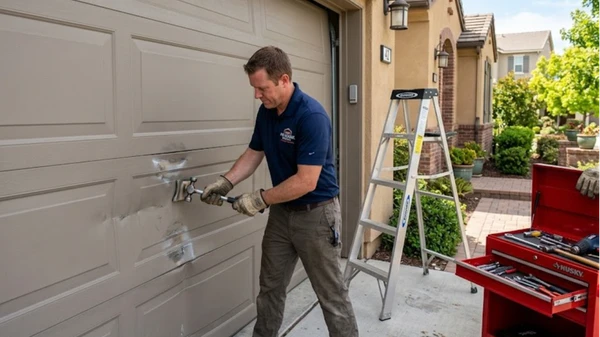
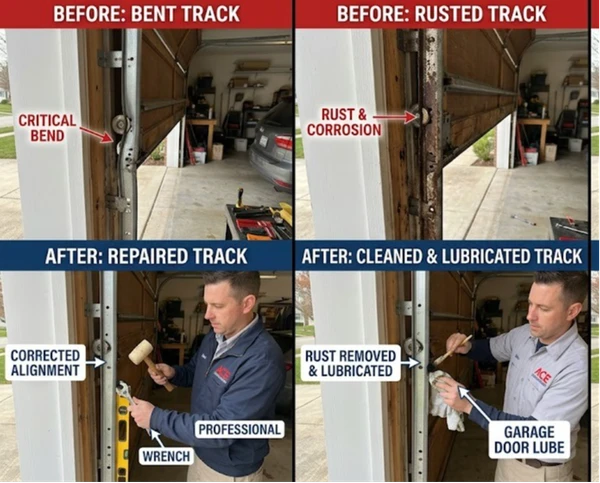
For a minor shallow dent - the kind where the track is deflected but not kinked, no sharp crease in the metal - there's a DIY path. Loosen the two mounting bracket bolts nearest the damaged section slightly, just enough so the track has a little play. Position a piece of scrap wood against the inside face of the bent section, and tap it back toward plumb with a rubber mallet. Gentle persuasion, not hammering. Never use a bare metal hammer on the galvanized steel surface - it chips the zinc coating and starts a rust clock that's hard to stop.
Where this approach stops working: any bend that's left a sharp crease in the metal, multiple bends at different points, or anything in the curved radius section at the top. The radius curve has to be exactly right or the rollers bind on every pass through it. Restoring that geometry by hand is essentially impossible to do accurately. Once the radius is compromised, replace the section. Trying to fix it usually makes it worse.
Misalignment: the slower, sneakier problem
Misalignment is different from bending. The track's shape is fine - it's the track's position that's wrong. Too far from the door, too close, not parallel to the other side, vertical sections that aren't plumb, horizontal sections that have dipped or risen out of level.
It develops gradually and that's why it's sneaky. Foundation settling moves the wall framing by fractions of an inch over years. Mounting brackets loosen from constant vibration. An opener that's slightly off-center applies torque that slowly walks the track out of position. You don't get a sudden problem - you get a door that starts sounding slightly worse, then worse than that, then the opener is working harder than it used to, then one day the door is visibly crooked.
There's a simple diagnostic test. Close the door and look at the gap between the roller and the inside of the track wall. It should be even and consistent along the full length - roughly the width of a nickel. If the roller is pressing against one wall of the track, or if the gap is noticeably larger on one side than the other, the track has drifted from where it should be.
Minor misalignment on one section - a single bracket that's shifted, a short run that needs adjustment - is fixable at home. Loosen the bracket bolts, reposition the track, retighten while checking with a level. The vertical sections should be plumb, horizontal sections should be level. They don't need to be within a thousandth of an inch, but they need to be close.
Misalignment that extends across multiple sections, or any situation where you've adjusted the same track twice and it keeps drifting, points to something else - a bracket with damaged mounting, wall framing that's moved, a structural issue that adjustment alone won't permanently address. That's a professional diagnosis.
Rust: the one that gives you plenty of warning and most people ignore anyway
Surface rust on steel tracks is cosmetic. The orange-brown film that develops in any moist environment, wipes off with a cloth, leaves the metal structurally intact underneath. Clean it with a wire brush, hit it with a rust converter to neutralize what's left, touch up the bare metal with galvanized spray paint. Done.
The reason I'm even mentioning it is that most people see surface rust and do nothing, and surface rust left alone eventually becomes the other kind. Deep pitting. Flaking patches inside the channel where the roller rides. Sections where the metal has lost enough thickness from oxidation that it no longer has the structural capacity it was designed for.
Deep rust creates drag. The opener has to fight it on every cycle, which puts extra stress on the motor, the drive system, and the spring system simultaneously. It accelerates roller wear because rough oxidized metal is abrasive. And a track section that's structurally weakened - particularly in the horizontal sections that support the full weight of the door while it's open - is a track that can fail in a direction you don't want.
The test is tactile. Press on a rusty section. If it feels solid and the surface is just discolored, clean it. If the metal feels soft, has visible pitting, or flakes when you press it with moderate finger pressure - replace the section. That's not a salvageable track.
Brackets: the thing that's actually wrong half the time
Bracket issues get misidentified as track issues constantly. The mounting brackets - L-shaped steel pieces that anchor the vertical tracks to the door frame, and ceiling-mounted brackets that hold the horizontal sections - take the same vibration load the door takes on every cycle, and the bolts work loose over years of use.
Before you assume the track needs to be adjusted or replaced, grab each bracket firmly and push against it in every direction. It should feel completely solid with zero movement. Any play at all means the mounting bolts need tightening. If the bolts tighten but the bracket still feels loose, the bolt holes have elongated in the wood framing - the bracket needs to move to fresh wood nearby.
The reason this matters: a track that keeps going out of alignment despite being adjusted multiple times almost always has a bracket problem nobody addressed. You can realign the track perfectly, but if the bracket it's attached to shifts an eighth of an inch under the door's operating load, the alignment problem comes back in a few weeks. Find and fix the bracket issue first.
Safety note worth taking seriously: the bottom bracket on the vertical track - floor level, where the lift cable attaches - is under direct spring tension. Do not touch it, do not loosen it, do not try to replace it yourself. The cable tension involved can cause violent, injury-causing release if the bracket is removed without first relieving the spring system through the correct procedure. This is one of the legitimately dangerous tasks in garage door maintenance. Leave it alone.
What repairs actually cost
These are 2026 figures for professional work:
|
What's needed |
Rough cost |
|
Track realignment, one side |
$100 – $175 |
|
Track realignment, both sides |
$150 – $250 |
|
Vertical track replacement, one |
$250 – $350 |
|
Vertical track replacement, both |
$350 – $500 |
|
Horizontal track replacement |
$400 – $550 |
|
Full track system replacement |
$500 – $800+ |
Door size, track gauge, whether the radius needs replacing, and local labor rates all move these numbers. The gap between a $125 realignment done early and a $600 full replacement done eighteen months later is the same gap my father-in-law lived through.
One thing that's wrong in a lot of maintenance guides
Don't put lubricant on the tracks. I see this advice everywhere and it's consistently incorrect.
Lubricant on the inside of the track channel attracts every dust particle, metal shaving, and grime fragment in the garage. Over weeks it builds into a gummy residue that causes the rollers to drag and can contribute to alignment shift. The tracks should be wiped clean with a dry cloth. That's the maintenance routine.
Lubricant goes on the rollers, the hinges, and the spring system. Not the tracks.
DIY vs. call someone
Reasonable to handle yourself: tightening loose bracket bolts, cleaning surface rust, a single shallow bend fixed with the rubber mallet and wood block method, minor alignment adjustment on one section.
Stop and call someone for: multiple bends anywhere, any bend in the radius curve, significant misalignment across more than one section, structurally compromised rust, a door that's come off the tracks completely, or any situation involving bottom brackets or cable hardware.
The moment track repair gets complicated is almost always a moment that involves spring tension nearby. That's not the context for figuring things out by trial and error.
DoorFixy handles track assessment, realignment, and replacement - including helping you figure out whether repair or full replacement is actually the right call for your door.
More garage door repair guides on the DoorFixy blog - practical and straight, without the upsell.