There's a garage door in my area - I pass it every morning - that sounds like a bag of gravel going through a dryer. You can hear it from the sidewalk. The family has lived with it for what sounds like years based on how worn the noise is.
I don't know them or I'd slide a note under the door. Because I'm about ninety percent certain the problem is lubrication. Not springs. Not a failing opener. Not some catastrophic mechanical issue that requires a service call. A $12 can of the right product and maybe half an hour.
Garage door lubrication is probably the single most neglected maintenance task on any residential property. And it's neglected specifically because the consequences are gradual - the door gets a little noisier, a little stiffer, a little harder on the opener motor, all of it so slowly that it becomes the new normal before anyone notices how far it's drifted.
Here's how to do it correctly, including which products to actually use.
The product question - because this is where people go wrong first
WD-40 is not a lubricant. I know it says lubricant on the can. The formulation most people use - the classic blue and yellow spray that exists in roughly 80% of American garages - is primarily a water displacer and light solvent. It does loosen corroded fasteners. It does displace moisture. What it doesn't do is leave a lasting lubricating film. Within a few days of application, whatever WD-40 you've sprayed on has evaporated or dispersed, leaving behind a residue that actively attracts dust and grime. You end up with more friction than you started with after a week.
There's a WD-40 Specialist line - different products, different formulations, actually designed for lubrication. That's fine. The original blue-can WD-40 is not.
What you actually want is one of two products:
Silicone-based spray lubricant is the better choice for most applications. It doesn't attract dust. It stays effective across a wide temperature range - which matters in hot summers and cold winters alike. It doesn't stain. It's thin enough to penetrate into tight spaces like hinge pins and bearing gaps. 3-IN-ONE Garage Door Lube and Blaster Garage Door Lubricant are the two products that come up most consistently from installers and technicians who aren't affiliated with any particular brand. Either works.
White lithium grease spray is the alternative for high-friction, high-load contact points - springs especially, or the opener rail. It's thicker, which means it stays put under mechanical stress better than silicone. The downside is that it's slightly more prone to attracting particles over time than silicone. Either product handles most of the job adequately. If I had to pick one to keep in the garage, I'd pick the silicone spray.
One thing to skip entirely: motor oil, general-purpose machine oil, cooking spray, or anything thick and petroleum-based. All of these attract grime aggressively and will make the problem worse over a period of weeks even if they temporarily quiet things down.
What to lubricate - and in what order
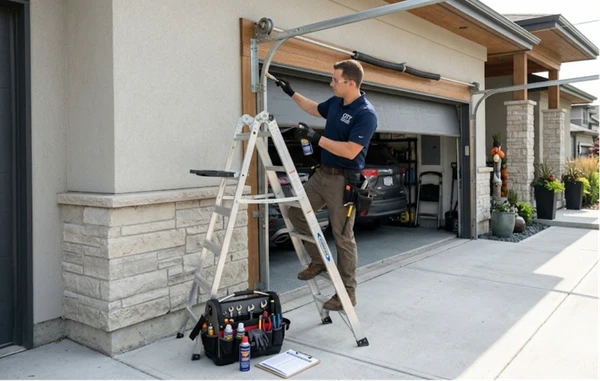
Unplug the opener before you start. Not just the wall button - the actual power cord from the outlet. You're about to manually cycle the door by hand, and you don't want it activating unexpectedly.
Hinges - every hinge on the door. There are usually eight to ten of them on a double-car door. The target is the hinge pin - the metal rod running through the hinge joint where the two panels articulate. Spray directly at the pin, a short burst. You'll see it work into the joint as you cycle the door. Don't soak the whole hinge body - that's wasted product that runs down the panel and accomplishes nothing.
Rollers - this one depends on what type of rollers you have. For steel rollers, spray the axle shaft where it enters the roller body and the roller bearings. The goal is to get lubricant into the bearing assembly, not coat the outside of the roller wheel itself. For nylon rollers with sealed bearings, you want to get lubricant around the stem/shaft interface and into the small gap between the stem and the nylon body - not on the nylon wheel face. Nylon doesn't need lubricating and coating it doesn't help. The sealed bearing inside is what matters, and the gap at the stem is usually accessible enough to get product in there.
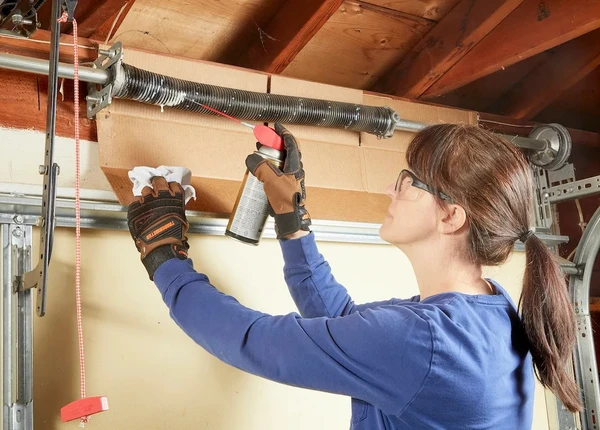
Springs - torsion springs run horizontally above the door opening on most residential doors. Extension springs run parallel to the horizontal tracks on either side. Both need lubrication, and both are worth doing carefully because they're under tension. For torsion springs: stand slightly to the side rather than directly underneath, apply the spray along the full length of the coil in a sweeping motion. The goal is light, even coverage along the entire spring. Don't try to get into the coils individually - the spray will wick in. For extension springs: same approach, spray along the length from a safe distance. The pulley wheels at the ends of extension springs can also be sprayed lightly.
Don't over-apply on springs. Excess lubricant drips off, accumulates on the floor, and can get onto the track - which is exactly where you don't want it.
Bearing plates - the metal discs mounted to the wall at each end of the torsion spring. There's a bearing inside each plate that the torsion bar rotates through. A short spray into the bearing center of each plate reduces friction on the spring system as it operates.
Opener rail - the metal channel running from the motor unit to the front wall bracket, where the trolley carriage travels. Apply lubricant along the full length of the top surface of the rail. For chain-drive openers, the chain gets a light application of lubricant as well. For belt-drive openers, the belt typically doesn't need lubricant and the manufacturer will usually specify this.
Opener arm and lock hardware - the connecting arm between the trolley and the door bracket, and the slide lock mechanism if you have one. Brief spray at the pivot points on the arm, and into the lock keyway and bolt mechanism.
What not to lubricate
The tracks. Do not put lubricant inside the garage door tracks.
I know this is counterintuitive - tracks are metal, the rollers run inside them, friction seems like the obvious enemy. But the tracks are supposed to remain dry. The rollers ride inside the track channel and need friction to maintain contact with the track wall. Lubricant on the track surface reduces that traction and contributes to the door running less predictably. More importantly, lubricant inside the tracks collects every dust particle and metal fragment in the garage. Within a few weeks you have a gummy buildup that creates more drag than the dry track would have. Clean the tracks with a damp cloth. Leave them dry.
Also skip: the plastic components on the opener motor unit, the safety photo-eye sensors, and the weatherstripping.
The technique detail that most guides skip
Amount matters as much as placement. More lubricant is not better. A thin, even coating that penetrates into joints and bearings is what you're after - not a dripping, saturated application that coats the surrounding door panels in spray residue.
Spray, then manually cycle the door two or three times by hand before re-engaging the opener. Opening and closing the door distributes the lubricant into bearing gaps and hinge joints that you couldn't directly access. After cycling, look for excess lubricant dripping off hinges or rollers - wipe those spots with a rag. Excess lubricant on panel surfaces isn't harmful, but it will collect dust and look grimy within a few weeks.
After wiping, plug the opener back in and run a full automatic cycle. Listen. The difference on a door that was genuinely dry should be immediate and obvious - quieter operation, smoother travel, less strain audible from the opener motor.
How often
Twice a year is the standard recommendation and it's a reasonable one for most climates. Spring and fall work well - you're lubricating before summer heat and before winter cold, both of which stress the metal components in different ways.
In harsh climates - coastal areas with salt air, upper Midwest or northern plains where doors may freeze up - quarterly lubrication is worth the extra twenty minutes. Salt air accelerates corrosion on anything unprotected. Extreme cold causes lubrication films to thin and reduces their effectiveness faster than moderate temperatures.
If you've never lubricated a door that's been in service for years, the first application should be heavier than a maintenance application - you're working into surfaces that may have been dry for a long time. Follow up with a second application two weeks later after you've run the door enough to distribute the first round.
When lubrication isn't enough
If you lubricate everything correctly and the door is still making significant noise, something is wrong with the hardware rather than just dry. A roller with a failed bearing won't quiet down with lubricant - the bearing is gone. A hinge cracked at the fold line will still creak. Springs that are worn beyond their service life may feel temporarily better but will fail anyway.
The diagnostic tell: does the noise improve immediately after lubrication and then return within a few days? That's usually a failing component that lubricant is temporarily masking. Does the noise not improve at all? Check the hardware physically for damage.
Lubrication that lasts less than two weeks between applications suggests either the wrong product (one that dissipates quickly), excess usage, or a component that's wearing through lubricant abnormally fast because of a mechanical problem.
DoorFixy handles full tune-ups including lubrication, hardware inspection, and balance adjustment - the kind of comprehensive service that catches what a lubrication run alone might miss.
More maintenance guides on the DoorFixy blog - practical advice that actually helps you understand your garage door.