Something I keep thinking about when I read home security statistics: roughly 9% of residential burglaries happen through the garage. That number has stayed consistent across multiple years of crime data. It hasn't come down meaningfully, even as front door security has improved dramatically with smart locks, video doorbells, and reinforced strike plates.
The garage is holding steady as a preferred entry point because people keep improving everything except the garage. They install a Ring doorbell on the front porch and call it done. The garage door - which is typically the largest single opening in the structure - gets a ten-year-old opener and whatever factory hardware it came with.
What follows isn't a scare piece. It's a practical list of what's actually exploitable about most residential garage doors and what specifically addresses each problem. Some of these take five minutes. A few require a small investment. All of them are worth doing.
1. Fix the emergency release cord exploit - today
This one gets mentioned in security guides occasionally and then people read past it without acting on it. Don't do that.
The emergency release cord is the red cord hanging from the opener carriage. Pull it and the door disconnects from the opener - manual operation from that point. It exists for power outages and opener failures. It's also reachable from outside the garage.
The gap between the top of a sectional door and the door frame above it is enough to pass a thin wire or hook through. A coat hanger, a purpose-made hook, a piece of stiff wire - any of these can catch the emergency release lever and disengage it. The whole process takes about fifteen seconds for someone who's done it before. The door lifts manually without any key, any code, any forced entry. No evidence of a break-in afterward.
The fix: a zip tie through the hole in the release lever limits how far the lever can travel - enough to function in a real emergency with sustained force, not enough to be tripped by a wire hook from outside. Purpose-made release shields are also available and are slightly more robust. Either option costs under $10 and takes three minutes to install.
If you do one thing today after reading this, it's that.
2. Upgrade your opener if it's more than 10 years old
This is a security upgrade that a lot of people don't know they need because they don't know how garage door opener technology works.
Older openers - anything manufactured before roughly 2010, and some older than that - used fixed codes. The opener and the remote shared a set code, like a password that never changed. Someone with a code-grabbing device could capture that code from a reasonable distance when you used your remote, then replay it later to open your door. This technology has been available on the open market for years and requires no particular technical skill to use.
Current openers use rolling code technology - sometimes called Security+ or Security+ 2.0 depending on the brand. The code changes every single time the remote is used, synchronized between the remote and the opener. A captured code is useless because it's already expired. A brute-force code attempt faces a space large enough that guessing is not a practical strategy.
If your opener is old enough to use a fixed code, it's a specific technical vulnerability that a rolling-code replacement closes permanently. An entry-level current-generation opener with rolling code runs $150 to $250. The security improvement is significant and the quieter, smoother operation is a bonus.
3. Add a keyed lock to the garage door itself
Most garage doors don't have an external lock. The opener locks the door in place when it's closed, but if the opener is compromised, bypassed, or simply unpowered, the door has nothing else holding it shut.
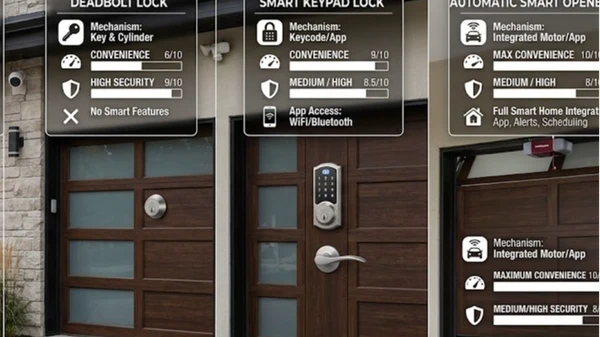
A T-handle keyed lock is the standard solution - a keyed cylinder in a T-shaped housing that drives a horizontal bar into the door tracks on both sides when locked. External access, two-point engagement, physical barrier that works regardless of the opener's status.
Standard T-handle cylinders are decent, not impressive. They can be picked or bumped by someone with basic lock bypass skills. If you want meaningful resistance at this layer, upgrade the cylinder to a high-security option - Medeco and Mul-T-Lock both make cylinders that fit standard T-handle housings. The housing costs $20 to $30. The cylinder upgrade costs $40 to $80 more. The combined result is a keyed lock that resists picking and bumping at a level that will make most burglars move on to an easier target.
4. Secure the interior door like an exterior door
This is the security gap that gets skipped in almost every garage security guide, which is baffling because it's arguably the most important one.
The door between your garage and your house - usually opening into a kitchen, mudroom, or hallway - is the last barrier between an intruder who has gotten into your garage and your living space. In most homes built in the last few decades, that door is: hollow-core, fitted with a passage handle rather than a deadbolt, and sometimes not locked at all because the homeowner figures the garage door itself is the security perimeter.
Once someone is inside your garage, they're in a private enclosed space with cover from the street. They can spend as long as they need on the interior door. A hollow-core door with a passage handle takes one firm kick. That's the actual entry point.
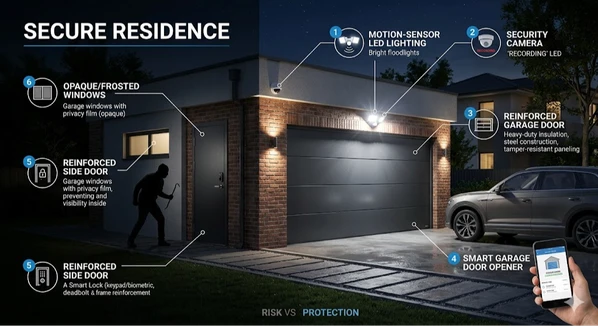
Fix it like an exterior door: solid-core door, keyed deadbolt, and a security strike plate with three-inch screws reaching the structural framing behind the door frame. The screws are as important as the hardware - a deadbolt is only as strong as its mounting into the wall. Short screws that only reach the doorframe wood, not the studs behind it, can be defeated by a single kick regardless of the bolt quality.
Total cost for the hardware upgrade if the door is decent quality: $100 to $200. Replace the door itself if it's hollow-core: add $200 to $400 depending on whether you hire someone. This is the most impactful garage security investment most homeowners aren't making.
5. Don't leave the remote in the car
This one is so simple that it almost doesn't deserve to be on the list, except that most people still aren't doing it.
A garage door remote clipped to a sun visor or sitting in a cup holder is a garage door opener for anyone who breaks into the car. Car break-ins are significantly more common than home break-ins, and they're often low-effort - a smashed window, a door left unlocked, a few seconds of opportunity. Anyone who gets into your car and finds the remote can then access your garage, and from there your house.
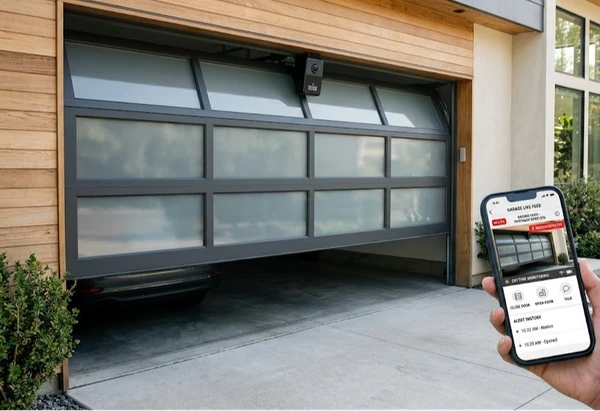
The solution is a keychain-format remote rather than the visor clip style, so the remote leaves the car with you. Alternatively, a smart opener that uses your phone as the remote entirely eliminates the physical remote from the equation.
If you can't immediately remember where your garage remote is right now, go check. If it's in the car, that's the next thing to change.
6. Add motion-activated lighting to the garage approach
Burglars, as a category, strongly prefer working in the dark. This is not a stereotype - it's a documented pattern from interviews with convicted burglars. Concealment from neighbors, from cameras, from passersby is a meaningful operational requirement for casual opportunists and organized crews alike.
A motion-activated flood light mounted above the garage door - positioned to cover the full approach and both sides of the opening - removes the concealment that darkness provides. When someone approaches your garage after dark and a 1,000-lumen light snaps on, two things happen: they're visible to anyone who happens to be looking, and they know they're visible. Most people who were considering something opportunistic move on immediately.
This doesn't stop a determined, prepared intruder. Nothing stops a fully determined professional who's done planning. But the majority of residential garage break-ins are opportunistic, not planned, and lighting is a genuine deterrent to the opportunistic majority.
Position lights at 9 to 10 feet above the ground for the widest coverage angle. Test the motion trigger zone during daylight so you know exactly what it covers. Adjust it until the full garage approach - driveway, door face, sides - is included in the detection area.
7. Frost your garage door windows
If your garage door has windows - or any windows on the garage walls - they give anyone walking by a free inventory of what's inside. Power tools on the wall. Bikes. A second car. Exercise equipment. The visible presence of expensive items is a motivation factor.
It also tells people when nobody's home. One car instead of two. Everything exactly where it was yesterday. For households with predictable routines, this is more information than it should be.
Frosted window film is the practical solution. Self-adhesive privacy film - the kind that diffuses light rather than blocking it - lets natural light into the garage while eliminating the view from outside. It costs $15 to $40 for a roll that covers several windows. Application is straightforward: clean the glass, cut the film to size, apply with a squeegee to push out air bubbles. Reversible, renter-friendly, and genuinely effective.
The alternative for doors with existing windows is tinted or obscure glass inserts - more permanent and more polished-looking, useful if you're replacing the inserts for other reasons anyway.
Putting it together
None of these individually makes your garage impenetrable. What they do collectively is make your garage a noticeably harder target than your neighbors' - which is, in practical terms, how residential security actually works.
Burglars make decisions the same way everyone else does. They read the environment, assess the difficulty, and choose the path of least resistance. A garage with motion lighting, a zip-tied emergency release, a rolling-code opener, a keyed T-handle lock, and a solid interior door is a substantially different proposition than the median residential garage. Most people will walk past it.
Start with what costs nothing - the zip tie on the release cord, locking the interior door every night. Then the motion light if you don't have one. Then the keyed lock. Then the opener if it's old enough to use fixed codes. The security layer compounds with each addition.
DoorFixy can help with lock installation, opener upgrades, and a full garage door security assessment - identifying the specific gaps in your setup before someone else finds them first.