Most homeowners have never thought about this distinction because most homes just have whatever came with the house. But if you're replacing a door, building a new garage, or dealing with a space where the standard setup doesn't quite work - understanding the actual difference between these two types matters more than most buying guides let on.
Here's a real comparison.
What each one actually is
Sectional garage doors are what the vast majority of American homes have. The door is made up of four or five horizontal steel panels connected by hinges. When the door opens, the panels travel vertically up the tracks, then curve along the horizontal track sections that run back toward the ceiling. The door ends up parallel to the ceiling when fully open. This is the standard residential setup.
Roll-up garage doors - also called coiling doors or rolling steel doors - work completely differently. Instead of panels on tracks, a roll-up door is made of interlocking horizontal slats that coil around a barrel mounted above the door opening. When the door opens, the slats wind around the barrel. No tracks running along the ceiling, no horizontal sections going back into the garage.
Those are the two fundamentally different mechanisms. Everything else follows from there.
Where roll-up doors are common
Walk through a commercial district and look at the storefronts with metal shutters rolling up. That's a roll-up door. Self-storage units - every individual unit door is a roll-up. Loading docks, warehouses, fire stations, commercial garages - almost all roll-up.
Residential use of roll-up doors is less common but it exists in specific situations where sectional doors don't work well. Garages with very limited headroom. Garages where ceiling space is needed for storage and you don't want tracks running back toward the ceiling. Some custom modern homes where the aesthetic is intentional.
Headroom - the big practical difference
This is where most people encounter the choice in real life.
Sectional doors need headroom - space between the top of the door opening and the ceiling - for the horizontal track sections and the opener mechanism. Standard requirement is about 10 to 12 inches minimum of headroom above the opening. Low-headroom sectional door hardware exists and can reduce this to about 4 inches, but it's specialized and more expensive.
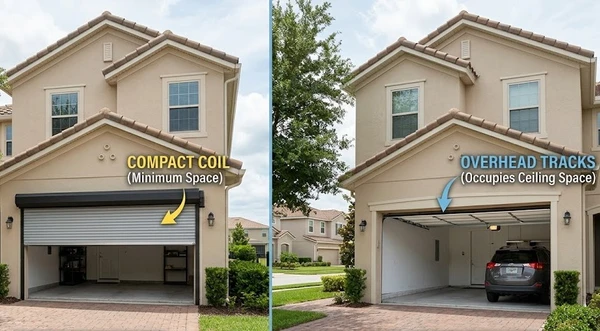
Roll-up doors need almost no headroom above the opening. The barrel sits right above the opening and the door coils directly up into it. If your garage has only a few inches between the top of the opening and the ceiling - or if there's a beam directly above the door - a roll-up might be the only option.
If headroom is your specific problem, this is the main reason to consider a roll-up for a residential application.
Ceiling space - another practical consideration
Standard sectional doors, when fully open, occupy the horizontal space running back from the opening along the ceiling. If you have a 7-foot door height and 20 feet of garage depth, roughly the first 7 feet of ceiling depth are occupied by the door when it's open. The opener hangs from this zone too.
For garages where ceiling storage matters - overhead racks, lifts, bikes hanging from the ceiling - a sectional door competes for that space.
A roll-up door, when fully open, is entirely contained in the barrel above the opening. The ceiling back into the garage is completely clear. This is why commercial operations with ceiling-mounted equipment almost exclusively use roll-up doors.
If you're planning significant ceiling storage and the door competes for that space, this matters.
Insulation - sectional wins clearly
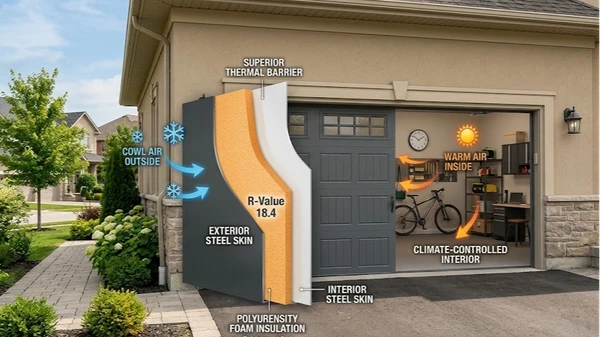
Sectional doors are available with serious insulation. Three-layer polyurethane construction, R-values up to R-20, full thermal break, quality perimeter sealing. If energy efficiency matters - attached garage, living space above, climate control - sectional doors have the insulation options to deliver it.
Standard commercial roll-up doors are made of aluminum or steel slats with no insulation. They're designed for durability and function, not thermal performance. Insulated roll-up doors exist - there are residential roll-up designs specifically marketed with foam-filled slats - but the insulation performance doesn't reach what quality sectional doors achieve. The slat-to-slat gaps in a coiling door also create thermal bridges that don't exist in a sealed panel door.
If you're in a climate where insulation matters and the garage is attached to living space - sectional door is almost certainly the right answer.
Durability and maintenance comparison
Commercial roll-up doors are genuinely built to take a beating. Steel slats, simple coiling mechanism, no panels to dent, no track sections to go out of alignment from a car backing into them. In a commercial environment with heavy use, forklifts, and rough handling - roll-up doors outlast sectional doors significantly.
In a residential environment with normal use - this advantage narrows. A quality sectional door lasts 15-20+ years with reasonable maintenance. The specific failure modes are different but the longevity is comparable.
Maintenance differences: sectional doors have more components - rollers, hinges, springs, tracks, opener. More components means more things to check and maintain. Roll-up doors have fewer moving parts in the panel itself but the torsion spring (or springs) above the barrel and the barrel mechanism need their own maintenance. The coiling mechanism can also get contaminated with debris that causes noise and wear.
Damage response is different. A car backing into a sectional door damages one or two panels - the rest of the door is fine, and damaged panels can often be replaced individually. A car backing into a roll-up door can damage multiple slats or jam the coiling mechanism, and individual slat replacement is less straightforward.
Aesthetic - a real difference for residential use
For most residential homes, sectional doors look right. They match the architecture of residential construction. They come in wood, steel, aluminum, composite, with or without windows, in dozens of styles from traditional raised panel to carriage house to flush modern.
Roll-up doors on a residential garage have a distinctly commercial or industrial look. On a contemporary or modern home where that aesthetic is intentional - sleek aluminum slats, clean lines - it works well. On a traditional suburban home, a roll-up door looks out of place.
This isn't a small consideration. The garage door covers a significant portion of a home's front elevation. The wrong visual choice is visible every time you or anyone else approaches the house.
Cost comparison
Standard residential sectional door installed - $800 to $1,800 depending on material, insulation, and size.
Residential roll-up door installed - pricing varies more widely because the market is less standardized. Basic aluminum roll-up for a single car opening starts around $900-1,200 installed. Better quality insulated residential roll-up doors can run $1,500-2,500+.
The cost difference isn't dramatically in favor of either type for residential applications. Sectional doors have the advantage of a very competitive, standardized market with many installers familiar with the product. Roll-up residential installations are more specialized and finding a quality installer who does them well matters more.
Security
This one often surprises people. Roll-up doors - especially commercial steel ones - are generally harder to break into than sectional doors. Steel slats are difficult to pry or cut through. There's no panel joint to exploit and no spring system that can be manipulated from outside.
Standard sectional doors have the emergency release cord that can be triggered through a gap at the top of the door with a wire hook - a known break-in method. Quality openers have release cord shields and security features to address this, but it's a real vulnerability on older or unmodified systems.
For most residential applications, this security difference is academic. Garages have other entry points that are usually more vulnerable. But for someone specifically concerned about roll-up vs sectional from a security standpoint - roll-up steel wins.
How to actually decide
If your garage has normal headroom (10+ inches above the opening) and is attached to the house - get a sectional door. Better insulation, more style options, more installers who know the product, easier maintenance.
If you have severe headroom limitations (under 4-6 inches above the opening) and insulation isn't critical - roll-up is worth looking at.
If ceiling space for storage or overhead equipment is a genuine priority - roll-up keeps the ceiling clear.
If aesthetics matter and the home is traditional or suburban - sectional fits better.
If the aesthetic is intentionally industrial or modern and that's a deliberate choice - roll-up can work well.
For the vast majority of residential applications, sectional is the right answer. Roll-up serves specific situations well but isn't the right default choice for a home.