Sounds like a simple question. Single car or double car - you have one garage opening or two, pick the door that fits. But it's actually worth thinking through more carefully than that, especially if you're replacing a door or building new and have some flexibility in how the opening gets configured.
Here's the full breakdown - dimensions, costs, practical tradeoffs, and situations where the less obvious choice actually makes more sense.
Standard dimensions - what "single" and "double" actually mean
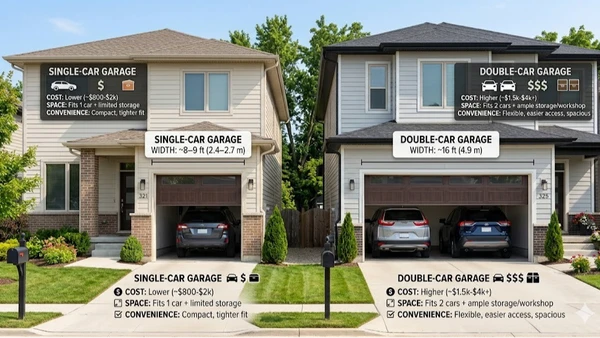
Single car doors - the standard widths are 8 feet and 9 feet. Height is almost always 7 feet on standard residential construction, though 8-foot height doors are increasingly common as trucks and SUVs get taller.
8 feet wide is the traditional standard. Works for most sedans, smaller SUVs, and compact trucks. Tight for full-size trucks and larger vehicles - you clear the opening but there's not a lot of margin.
9 feet wide is the current preferred width for new single-car openings. Gives comfortable clearance for most vehicles including full-size trucks, and makes parking less stressful because you don't have to thread the needle every time.
Double car doors - standard widths are 16 feet and 18 feet. Height is again typically 7 feet standard, 8 feet increasingly common.
16 feet is the traditional standard double car. Two vehicles side by side with reasonable space. Works for most vehicle combinations.
18 feet is the roomier option. Better if both vehicles are full-size, if you want more comfortable entry and exit with doors open in the garage, or if you park anything larger than a standard passenger vehicle.
Non-standard widths exist - 10-foot singles, 12-foot singles, 20-foot doubles - but these are less common and sometimes require custom or semi-custom doors. Pricing goes up when you leave standard dimensions.
Two singles vs one double - the real choice
This is where the conversation gets interesting. If you have a two-car garage, you have a choice: one wide double door covering both bays, or two separate single doors side by side.
Most people don't think about this as a choice - they assume they'll get a double if they have two cars. But the two-singles configuration has real advantages worth knowing.
Independent operation. Two single doors means each door operates independently. One person leaving early in the morning only opens their side. No waking up the household by opening the full 16-foot double door when only one car is leaving.
Failure doesn't affect both bays. If a spring breaks on one door, that door is down. The other door still works. With a double door, one spring failure takes out access to both bays.
Structural separation. A double-car opening is a wide opening in the garage wall. Two single openings have a center column between them. That column adds structural rigidity to the garage wall. In earthquake-prone areas or regions with high wind loads, this can matter. Some building codes in specific regions actually require the center post for this reason.
Cost of repair over time. Single doors have smaller, lighter, less expensive springs. When they need replacement, the cost is lower than the heavier springs required for a wide double door.
One looks better on some houses. This is subjective but real. Some home styles - especially narrower older homes - look better with two distinct door openings than with one wide double door that dominates the facade.
When a double door makes more sense
Simpler operation. One button, one door opens. No confusion about which remote does what, no separate openers to maintain, no kids opening the wrong door.
Easier tandem parking. Some garages are set up for tandem parking - two cars parked one behind the other rather than side by side. With a double door and this layout, there's only one door to deal with.
Cost of initial installation. One door and one opener is cheaper to install initially than two doors and two openers. If upfront cost is the primary consideration, a double is less expensive to set up.
Wide load access. If you ever bring in large equipment - riding mowers, trailers, boats on a trailer - the full 16 or 18-foot opening is easier to navigate than two separate 8 or 9-foot openings.
Appearance on wider homes. On a wide ranch-style house or a larger home with an expansive garage facade, a well-chosen double door can look more proportionate and intentional than two separate doors.
Cost comparison - door only
These are installed prices for standard steel insulated doors in mid-range quality (good brands, three-layer construction, R-12 to R-16) in 2026.
Single car door (8x7 or 9x7) - $800 to $1,300 installed including opener.
Two single car doors for a two-car garage - $1,600 to $2,600 installed including two openers. Roughly double the single-door price, which makes sense.
Double car door (16x7 or 18x7) - $1,200 to $2,000 installed including opener. Less than two singles because it's one door and one opener.
The double door costs less upfront. But factor in the long-term repair cost difference - springs for a double door cost more to replace, and one failure takes out both bays - and the gap narrows over the life of the door.
Cost drivers that move prices up
Non-standard height. 8-foot tall doors instead of 7-foot add $100-250 to the door cost. If you have trucks or tall SUVs that feel cramped going through a 7-foot opening, the upgrade is worth it.
Material upgrade. Steel is the baseline. Wood composite or faux wood adds $300-800 to a single door. Real wood is more than that. Aluminum with glass for a modern look is in the $1,500-3,000+ range for a single car door.
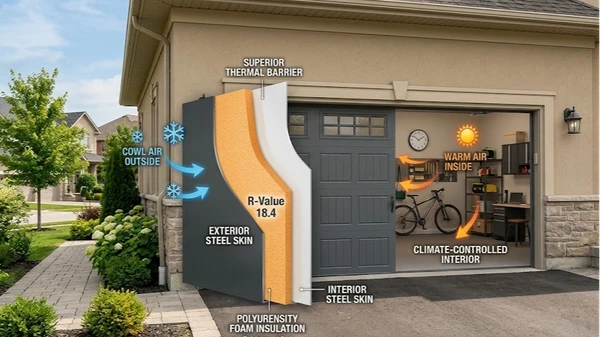
Insulation level. R-6 to R-9 is mid-range. R-12 to R-18+ adds $100-400 to the door price depending on construction and brand.
Windows. A row of windows in the top panel is a popular option. Adds $100-250 depending on number and glass type.
Smart opener. Upgrade from standard to WiFi-connected opener with app control and battery backup - adds $100-200 to the opener portion.
The height question - 7-foot vs 8-foot doors
More important than most people think about before they buy.
Standard 7-foot door height has been the norm for decades and works fine for most passenger vehicles. But modern full-size trucks and many SUVs are taller than they were 20 years ago. If you have a truck with a roof rack, a van, or anything that sits high, measure your vehicle's height before committing to a 7-foot door.
The math: garage opening height needs to be taller than your vehicle's height plus a few inches of clearance. The door height and the opening rough frame height are related but not the same - the door sits in a frame, so the actual clear opening height is roughly the door height minus a couple inches for hardware.
8-foot door openings were once rare in residential garages and are now increasingly standard in new construction. If you're replacing an old door on an existing opening, you're constrained by the existing rough frame height. If you're doing new construction or a major garage renovation, going 8-foot height is worth the modest extra cost.
The opener question - one or two
Double door: one opener, one remote. Simple.
Two single doors: two openers, two remotes (or a dual-button remote that operates both from one button). More to set up, but modern dual-button remotes are inexpensive and make the two-opener setup nearly as convenient as one.
Each opener is smaller and less expensive for a single door - lighter door, smaller spring, smaller motor. The long-term cost of maintaining two single-door openers over 15 years is not significantly different from one double-door opener when you factor in the spring replacement cost difference.
Making the call
If the garage opening is already framed as a double - get a double door. Reconfiguring a framed opening is a structural project that costs more than the door itself.
If the opening is already framed as two singles - get two single doors.
If you're building new or doing a major renovation and have a choice - here's the shortcut:
Two cars and you leave at different times regularly → two singles, independent operation.
Two cars and you usually leave together → double is fine, simpler.
One car with extra space used for storage or workshop → single 9-foot door is plenty.
Structural concerns in a seismic or high-wind area → check local codes, may require center post (two singles).
Budget-limited upfront → double is cheaper initially.
Budget-conscious long-term → two singles often come out ahead over the life of the system.