Most people shopping for a new garage door spend about 90% of their time thinking about color and style. Maybe 10% on price. And somewhere close to zero on R-value.
That's backwards.
The R-value of your garage door quietly affects your energy bills every single month. It determines whether your attached garage stays somewhat close to room temperature in January - or feels like a walk-in freezer. It protects tools, paint cans, and cars from temperature damage. And it affects how much noise bleeds in from the street.
Getting it right isn't complicated. You just need to know what the number actually means and which one fits where you live.
What Is R-Value, Exactly?
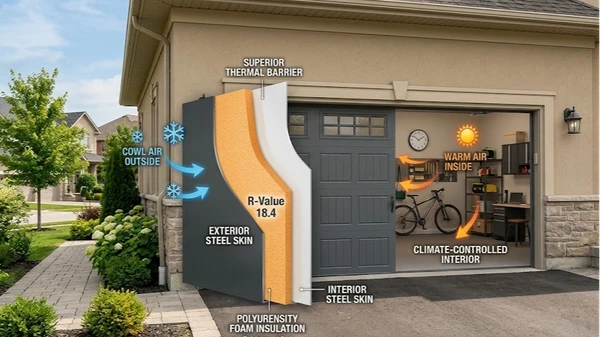
R-value measures thermal resistance - how well a material slows the movement of heat. The higher the number, the harder the door works to keep outside temperatures outside.
A garage door rated R-6 lets heat pass through much more easily than one rated R-16. That gap shows up on your utility bill, especially if your garage is attached to your home.
Two things worth knowing upfront:
Polyurethane vs. polystyrene - These are the two main insulation materials used in garage doors. Polyurethane is injected foam that expands to fill every gap in the door panel. It's denser, stronger, and delivers a higher R-value per inch. Polystyrene is the rigid board type - cheaper, decent, but not as efficient. If performance matters to you, polyurethane wins.
Whole-door vs. center-panel R-value - Some manufacturers quote the R-value at the center of the panel only, not the entire door. The edges, frame, and seals can drag the real-world number down. Worth asking your dealer which measurement they're advertising.
R-Value Ranges: What Each Level Actually Gets You
Before we get climate-specific, here's the quick breakdown of what the numbers mean in practice:
|
R-Value Range |
Door Type |
Best For |
|
R-0 to R-6 |
Single-layer, uninsulated |
Detached garages, mild climates, storage only |
|
R-7 to R-12 |
Double-layer, polystyrene |
Attached garages, moderate climates |
|
R-13 to R-16 |
Triple-layer, polyurethane |
Cold climates, attached garages, heated spaces |
|
R-17 to R-20+ |
Premium polyurethane |
Extreme climates, workshops, living spaces above |
R-Value by Climate Zone: What You Actually Need
This is where most guides get vague. Let's be specific.
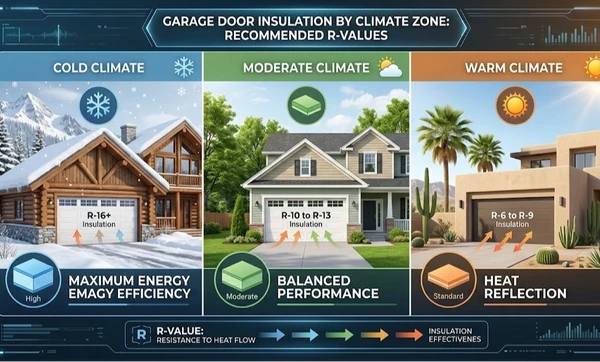
☀️ Hot Climates - Southern States, Southwest, Florida (IECC Zones 1–2)
Think: Phoenix, Miami, Houston, Las Vegas, New Orleans
The problem in hot climates isn't keeping heat in - it's keeping it out. An uninsulated garage in Phoenix can hit 120°F on a summer afternoon. That heat radiates into your home and forces your AC to work overtime.
Recommended R-value: R-12 to R-16
Polyurethane insulation handles the heat load better than polystyrene here. Also pay attention to door color - lighter finishes reflect solar radiation and keep surface temps lower. Humid southeastern states need moisture-resistant materials and tight weatherstripping to prevent condensation.
🌤️ Mixed/Moderate Climates - Mid-Atlantic, Pacific Coast, Midwest Transitional (IECC Zones 3–4)
Think: Charlotte, Los Angeles, Kansas City, Nashville, Atlanta
You're dealing with both summer heat and real winters, just not the extreme version of either. An attached garage here needs insulation that handles temperature swings in both directions.
Recommended R-value: R-10 to R-14
For attached garages that connect directly to your home, aim for the higher end of that range - R-13 or R-14. For detached storage garages, R-10 is plenty. This is the range where the cost-to-benefit math really works in your favor.
🌨️ Cold Climates - Upper Midwest, Northeast, Mountain West (IECC Zones 5–6)
Think: Chicago, Minneapolis, Denver, Boston, Detroit, Cleveland
Cold-climate homeowners feel this one the hardest. An uninsulated or under-insulated garage door bleeds heat constantly - especially with an attached garage sharing a wall with your home. Your furnace picks up the slack. Your bill reflects it.
Recommended R-value: R-13 to R-18
For basic vehicle storage in an attached garage, R-13 is the floor. If you heat your garage, use it as a workshop, or have living space above it - go R-16 to R-18. The price difference between a good R-13 door and an R-18 door is often a few hundred dollars. The energy savings over five winters can pay for that gap easily.
🥶 Very Cold / Extreme Climates - Upper Midwest, Alaska, Northern Plains (IECC Zones 7–8)
Think: Minneapolis winters, Fargo, Anchorage, northern Montana
This is where you need to stop thinking about "decent" insulation and start thinking about maximum. Subzero temperatures find every weak spot fast.
Recommended R-value: R-16 to R-20+
At this level, you want a triple-layer door with injected polyurethane foam and tight weatherstripping at the bottom and sides. Even a high R-value door loses effectiveness fast if cold air is sneaking in around the edges - that gap at the bottom seal can single-handedly cancel out 20–30% of your door's insulation value. Seal quality matters just as much as the number on the spec sheet.
One More Factor People Forget: How You Use Your Garage
Your climate is only half the equation. The other half is what happens inside the garage.
Parking cars only - You can drop down one tier from the climate recommendation above. The garage doesn't need to be comfortable, just not destructive.
Workshop or home gym - Go up a tier. You'll be in that space for hours. Temperature swings are miserable to work in and can warp tools, damage equipment, and affect finishes.
Living space above the garage - The floor of that room is the ceiling of your garage. Poor insulation turns that floor freezing cold in winter and hot in summer. Aim for R-16 minimum, regardless of climate zone.
Storing paint, electronics, or chemicals - These items have temperature tolerance limits. Many paints freeze and separate below 50°F. Electronics degrade faster in extreme heat. An insulated garage door protects your stuff, not just your energy bill.
Quick Reference: What to Buy
|
Your Situation |
Minimum R-Value |
|
Detached garage, mild climate |
R-6 |
|
Attached garage, mild climate |
R-10 |
|
Attached garage, moderate climate |
R-13 |
|
Attached garage, cold climate |
R-16 |
|
Heated workshop or gym, any climate |
R-16 |
|
Extreme cold or living space above |
R-18 to R-20+ |
Bottom Line
R-value isn't a number to blindly maximize. A homeowner in San Diego spending for an R-18 door probably doesn't need it. A homeowner in Minneapolis running an R-8 door on an attached garage is definitely losing money every winter.
Match the number to your climate zone and how you use the space. That's it.
Need help picking the right insulated garage door for your home? The team at DoorFixy can walk you through options that fit your climate, your garage, and your budget - no guesswork required.